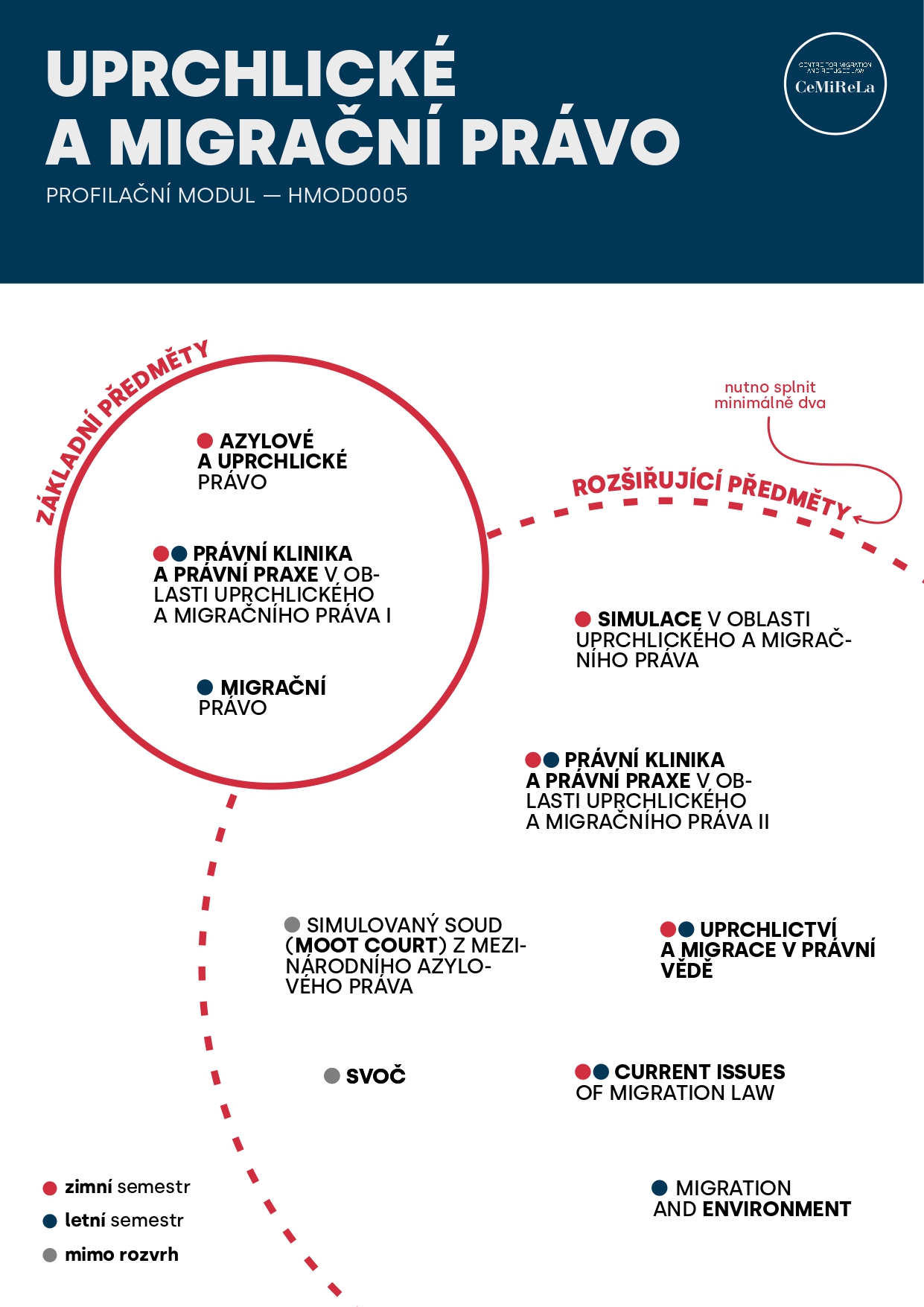
migration and asylum law Programme
The Centre of Migration and Refugee Law at the Faculty of Law, Charles University, coordinates the specialised study track Refugee and Migration Law Programme. The aim of this newly reformed programme is to provide in-depth knowledge of migration, asylum, and refugee law, building upon the students’ existing understanding of international, European, and administrative law.
methods and approaches
The programme combines theoretical, practical, and skills-oriented courses. Our teaching draws on innovative methods such as flipped classrooms and problem-based learning, and includes experiential formats like LARPs, moot courts, and legal simulations. Students also have the opportunity to participate in legal clinics, internships, and engage in academic research during their studies. This enables them not only to build a solid theoretical foundation, but also to meaningfully develop and apply their skills in real-world contexts.
Graduate Profile
Students completing the programme acquire a strong theoretical foundation, including historical context. Across all courses, they work with legal sources, interpret them, and apply them not only in theoretical subjects but also in practical and skills-oriented ones.
The curriculum covers domestic, European, and international law, offering a comprehensive, multi-level understanding of the field. In practice-oriented courses, students gain fundamental professional skills essential to legal practice, accompanied by feedback both from faculty members and external mentors at institutions where professional placements are carried out. Faculty and mentors closely cooperate to ensure the feedback is as constructive and effective as possible.
Students are also introduced to legal research methodology. Most courses require written assignments, which are assessed both in terms of content and form, including methodology. Practice-oriented courses also emphasize the ethical aspects of legal work and the social responsibility of legal professionals.
Students learn to draft legal documents, make submissions to public authorities, and represent clients before these bodies through simulations and, in some cases, legal clinics. They are trained to collect, organize, and assess materials, and prepare draft decisions. They also develop the ability to locate, structure, analyze, and interpret legal norms, case law, and other relevant information necessary for resolving legal and related practical issues. Graduates will be able to analyze, formulate, and present legal arguments and counterarguments—both orally and in writing—and identify and solve legal problems in specific real-world situations.
Graduates of the programme are well equipped for roles in public administration (particularly at the Ministry of the Interior of the Czech Republic), legal practice, the judiciary, international organizations, and the non-profit sector.
Students are also encouraged to enroll in selected courses at other faculties that enrich their understanding of refugee and migration law.
Examples include:
Geography of Migration and Integration of Foreigners at the Faculty of Science, Charles University
Anthropological Perspectives on Migration and Mobility in CEE at the Faculty of Humanities
Graduates of the programme will acquire both theoretical and practical training, enabling them to pursue careers across a wide range of legal professions – for example, in public administration (particularly at the Ministry of the Interior of the Czech Republic), in advocacy, administrative judiciary, non-governmental organizations working with migrants and refugees, or in international organizations. A certificate of completion of the programme will be included in the Diploma Supplement to the Master’s degree.