

Temporary protection in v4 countries
As part of the multi-year project Shelter Law-Making: Legal Response to Massive Migration Caused by Russian Aggression Against Ukraine, academics from the Visegrád Group countries examined the similarities and differences in the approaches of the Czech Republic, Hungary, Slovakia, and Poland to the implementation of the Temporary Protection regime in response to the 2022 Russian invasion of Ukraine, along with the broader legal framework associated with it. These countries—three of which share a direct border with Ukraine—collectively experienced the largest mass influx of displaced persons in their histories. Throughout the now more than three-year period of activated Temporary Protection, they have consistently ranked at the forefront of Europe in terms of the number of beneficiaries—both in absolute terms and, especially, relative to population size.
Although all of these countries—like the rest of the European Union—responded to the mass influx by activating the harmonized European instrument of Temporary Protection, their specific legal responses often differed significantly. It was precisely these divergences—alongside numerous similarities—that became the focus of a research project conducted between 2023 and 2025 by a team of researchers from four leading Central European academic institutions. These were:
Dr Hab. Iur. Aleksandra Mężykowska (Institute of Law Studies, Polish Academy of Sciences) – project coordinator
Prof. Dr Hab. Iur. Anna Młynarska-Sobaczewska (Institute of Law Studies, Polish Academy of Sciences)
Piotr Polak, MA (Institute of Law Studies, Polish Academy of Sciences)
JUDr. Věra Honusková, Ph.D (Právnická fakulta Univerzity Karlovy, Czechia)
Réka Friedery, PhD, LLM (Centre for Social Sciences, Institute for Legal Studies, Hungary)
JUDr. Miroslava Mittelmannová (Faculty of Law of Trnava University, Slovakia)
Lukáš Novák (The Human Rights League, Slovakia)
Would you like to…
…read the final report containing the results of this research?
The individual national reports as well as the joint final report are available here.
…read more about the project?
Click the link below to read more about the project’s objectives, scope, and methodology.
…find out more about Temporary protection in Czechia?
The data, legislative framework, and broader societal context are presented on our dedicated subpage on Temporary Protection.
…listen to an overview about Temporary Protection and its implementation?
Podcast „Dočasná ochrana tři roky poté“ covers the most important elements of the Czech implementation. Only in Czech.
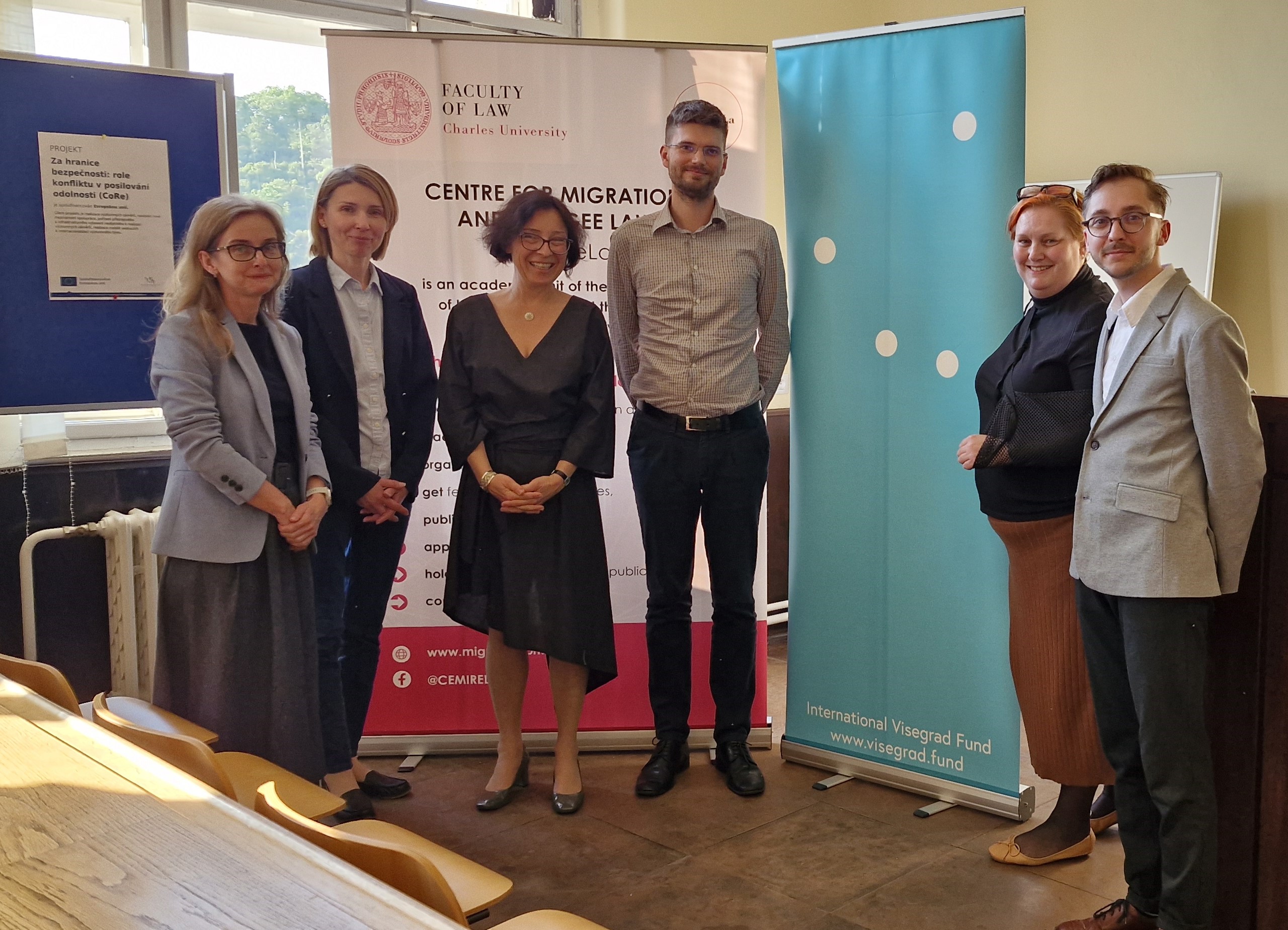
This project was made possible through the financial support of the International Visegrad Fund. We extend our gratitude!

